Saturday, June 24, 2006

Your Maugham-a!

Another of the Modern Library novels down -- Of Human Bondage by W. Somerset Maugham.

Not half bad; as S and I lounged at Punjabi by Nature last night to celebrate one year since my return to India, we debated its merits. The writing is simple, clear, and the story is rather charming. And I'm always drawn to works that explore the meaning of art, the whims of circumstance, and the methods for coping with a feel that one stands outside the world (an aside: what novel DOESN'T that describe?).

My only criticism -- and it is a rather large one -- is that Maugham perhaps belabors the themes of slavery, freedom, etc. There is a fine line between alluding to one's ideas and explicating a doctrine; Of Human Bondage is so transparent that at times it seems Maugham is more interested in expounding his personal philosophies than letting the writing and story take care of itself. Shrug.

Choice quoties:

"Insensibly he formed the most delightful habit in the world, the habit of reading: he did not know that thus he was providing himself with a refuge from all the distress of life; he did not know either that he was creating for himself an unreal world which would make the real world of everyday a source of bitter disappointment."

"'As long as you accept [your deformity] rebelliously it can only cause you shame. But if you looked upon it as a cross that was given you to bear only because your shoulders were strong enough to bear it ... then it would be a source of happiness to you instead of misery.'"

"'I do not attach any exaggerated importance to my poetical works. Life is there to be lived rather than to be written about. My aim is to search out the manifold experience that it offers, wringing from each moment what of emotion it presents. I look upon my writing as a graceful accomplishment which does not absorb but rather adds pleasure to existence. And as for posterity -- damn posterity.'"

"The advantage of living abroad is that, coming in contact with the manners and customs of the people among whom you live, you observe them from the outside and see that they have not the necessity which those who practise them believe. You cannot fail to discover that the beliefs which to you are self-evident to the foreigner are absurd. ... He saw that nothing was good and nothing was evil: things were merely adapted to an end."

"He thought of Hayward and his eager admiration for him when first they met, and how disillusion had come and then indifference, till nothing held them together but habit and old memories. It was one of the queer things of life that you saw a person every day for months and were so intimate with him that you could not imagine existence without him; then separation came and everything went on in the same way, and the companion who seemed so essential proved unnecessary."

"Thinking of Cronshaw, Philip remembered the Persian rug which he had given him, telling him that it offered an answer to his question upon the meaning of life; and suddenly the answer occurred to him ... The answer was obvious. Life had no meaning.... Life was insignificant and death without consequence. ... for the first time he was utterly free. His insignificance was turned to power, and he felt himself suddenly equal with the cruel fate which had seemed to persecute him; for, if life was meaningless, the world was robbed of its cruelty. What he did or left undone did not matter. Failure was unimportant and success amounted to nothing."

"Life was before him and time of no account. He could wander, for years if he chose, in unfrequented places, amid strange peoples, where life was led in strange ways. He did not know what he sought or what his journeys would bring him; but he had a feeling that he would learn something new about life and gain some clue to the mystery that he had solved only to find more mysterious."

Staggering stats

Morbid as it may be, news reports on suicide always draw my attention. And I'm always shocked at just how different the phenomenon is in the U.S. and India.

Today HT, in "Girls are more prone to [suicide]" by Suchita Sharma, highlights some of these discrepancies. Though her article emphasizes gender dynamics -- whereas in the West men are about four times more likely to commit (not attempt) suicide than women, in India women commit ~55% of suicides (according to an AIIMS study of suicides among persons aged 10-18 in South Delhi) -- the report also contains a number that absolutely blew me away.

Sharma writes:

"Suicide rates were double for girls in Tamil Nadu as compared to boys, reported The Lancet in 2004. The study reported a high average suicide rate for girls in the 10-19 years age group [of] 148 per 1 lakh [100,000] populationcompared with 58 suicides per 1 lakh boys. Globally, the suicide rate is 6.8 per 1 lakh for women, and 24 per lakh for men.

Researchers at Vellore's Christian Medical College, where the study was done, insist that their findings are not 'a local aberration.' 'We suggest that reported rates of suicide in other parts of India are low because identification of suicides is difficult owing to inefficient civil registration systems, non-reporting of deaths, variable standards in certifying death, and the legal and social consequence of suicide.'"

I find it shocking that the incidence of suicide among young women in this case is more than 21 times that in the West; and, even if you discount the gender effect, suicide seems -- according to this study -- a much larger problem here, though it is not accorded the same sociological space as in the U.S. (which could be one reason for discrepancy, but what do I know).

Thoughts? Mountain out of a mole hill, or genuine problem?

If you or anyone you know (in India) is considering suicide or has mentioned wanting to die, please contact one of these SUICIDE HELPLINES.

Sumaitri Befrienders India: 23389090
Sanjeevani Society for Mental Health: 24311918 or 26864488
Naz Foundation (India) Trust: 26851970 or 26851971
Tulsi Rehab Centre: 9891006875


Tuesday, June 20, 2006

So many penis jokes, so little time

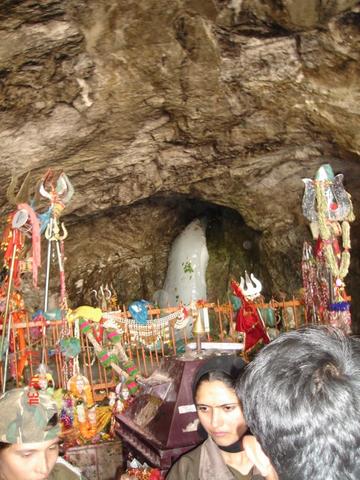
Again, a gem ripped from the headlines. The annual Amarnath yatra has commenced, and it wouldn't be India if there wasn't some bureaucratic bumbling around the corner.

Background (thank you, Wikipedia):

Amarnath: There are numerous explanations of how the journey to the cave came to be, but most people agree that some man (some say a Gujjar, some say a rishi) was bopping around the Himalayas and encountered a cave at Amarnath, wherein a lingam (widely considered a symbol of Shiva, a tantamount god in the Hindu pantheon) of ice had formed from water drizzling through the cave; Amarnath then became a symbol of Shiva’s abode and began attracting thousands of devotees seeking to bask in the shiv ling's presence.

Shiv ling: Various interpretations on the origin and symbolism of the Shiva lingam exist. While the Tantras and Puranas deem the Shiva lingam a phallic symbol representing the regenerative aspect of the material universe, the Agamas and Shastras do not elaborate on this interpretation, and the Vedas fail altogether to mention the Lingam.

Now that you're up to speed, let's see how this year's yatra is going. Actually, it's not so good. In "Amarnath shivling man made?", HT, June 17, Arun Joshi writes:

"Pilgrims to the Amarnath shrine this year would be disappointed to learn that the 'Shivlingam' at the cave shrine is man-made and not natural as it usually is. The extraordinary hot weather last month did not allow the Shivlingam to be formed. An official of the Shri Amarnath Shrine Board told the Hindustan Times that snow had to be gathered and shaped like a lingam. .. however, fresh snowfall on June 12, a day after the yatra began, rescued the architects of the man-made Shivlingam. Fresh snow was sprinkled around to make it look natural."

I can't help but laugh when I imagine the organizers frantically packing snow, panicked that the sacred symbol did not develop because the winter was unusually warm. No one seems to be that outraged, which is good, but it does remind me of the good 'ole college years.

See, if you attended my alma mater, you not only sympathize with the organizers, but you've probably participated in a more ritualized form of this subterfuge. For many dorms, upon the first snowfall of the year, take it upon themselves to erect gigantic phalluses from the flakes. In "Year's first major snowfall gets mixed reactions from students," The Daily Northwestern, March 6, 2003, Samantha Nelson reports:

"With Winter Quarter drawing to a close, an unexpected onslaught of snow has made Northwestern students realize how far away spring still is. 'I'm glad we finally got a good amount of snow, but it would have been nicer a few months ago, when I wasn't looking forward to spring,' said Samantha Starrett, a Weinberg freshman. But as long as the snow continues, she expects the fun will too. 'I wouldn't be surprised if semi-offensive sculptures start appearing,' Starrett said. 'I've heard terrible, terrible things about what [dorm] people like to build in the snow.'"

I'm just glad the puerile occupations of college students are now enjoyed by all ages, races, and creeds. Pack it tightly, boys.

Something smells...

I know, stupid joke, and yet...apt.

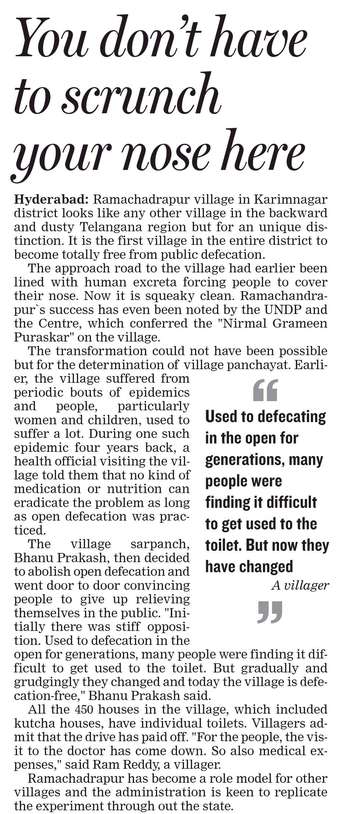
I refer, of course, to the masterpiece published in HT this morning, "Essentially India: You don't have to scrunch your nose here," by Ashok Das, on the subject of public defecation in backwater villages.

Yes, a menace more threatening than terrorism in Doda, more significant than the opening of the Nathu La pass to China...poop.

Das writes:

"The approach road to [Ramachadrapur] village had earlier been lined with human excreta, forcing people to cover their nose. Now it is squeaky clean...The village sarpanch, Bhanu Prakash, decided to abolish open defecation and went door to door convincing people to give up relieving themselves in public."

Alright, alright...perhaps I can buy this from a public health perspective. Until Das goes and makes these people look like complete and utter asses.

"'Initially there was stiff opposition. Used to defecation in the open for generations, many people were finding it difficult to get used to the toilet. But gradually and grudgingly they changed and today the village is defecation-free,' Bhanu Prakash said."

Let's set aside, for a moment, the way in which this drives a divide from the city folk -- pristine and clean atop their porcelain commodes -- and those backward village idylls. There are several possible reasons for such bald, idiotically constructed sentences to be printed:
1) The journalist is functionally illiterate;
2) The journalist finds this story hilarious and wants to make a spectacle of hard-fought progress;
3) The copy editor didn't read the story;
4) The copy editor doesn't have the sense that god gave a billy goat; or
5) The copy editor wants to mock the idiotic journalist and inspire readers to clutch at their breasts imagining the intestinal fortitude of these constantly constipated chaps

Sunday, June 18, 2006

Public service...


Citizens of Delhi: arm yourselves with a cell!

Yes, we all hate auto drivers, but we all have to deal with them on a semi-regularly basis, even if only to shout chuttiya! as the buzzing green and yellow vehicle putts slowly on a flyover.

Anyhow, I haven't tried this, and I don't know if it entails waiting with the jackass driver until the police show up or if you just send along the guy's registration number and our protectors take it from there, but it's an interesting concept.

Anyone tried it out? Will the ho-lice really take SMSes seriously, or is it a better tactic to get them on the telly? What next -- Internet complaints? Welcome to the twenty-first century, baby.

Sunday funday

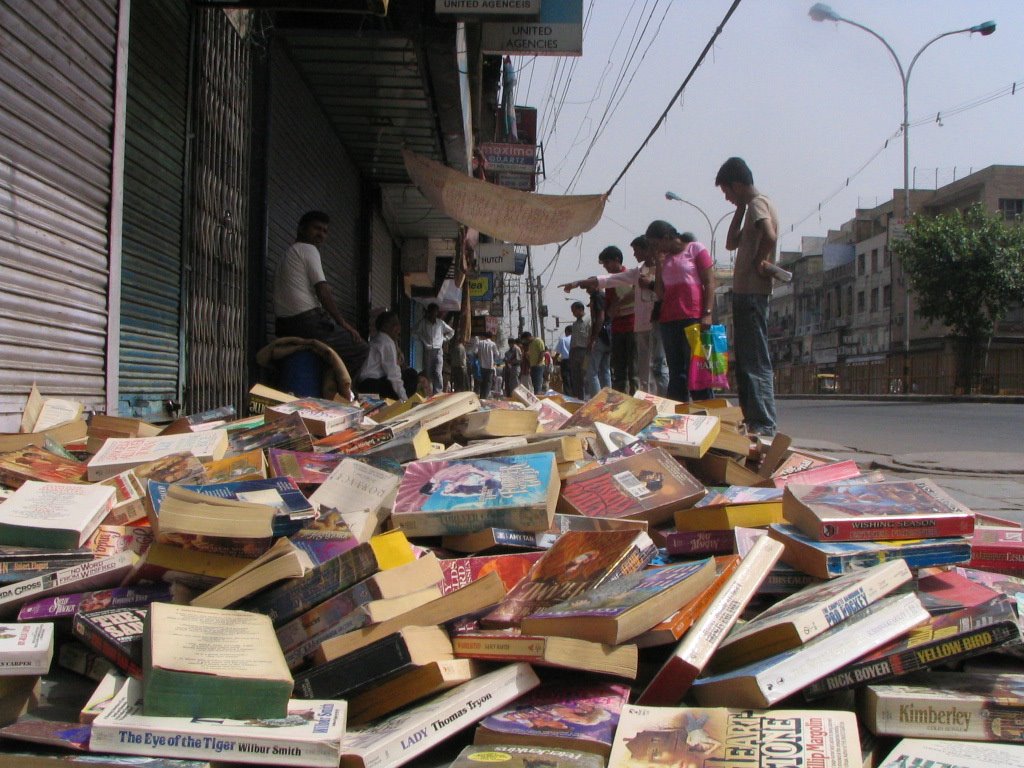
To hell with the Lord! My religion is literature.

Or something. Whatever the case, I love Daryaganj. Total damage? 11 books (most from the Modern Library list), about Rs 400. Not too shabby.

Freakonomics!

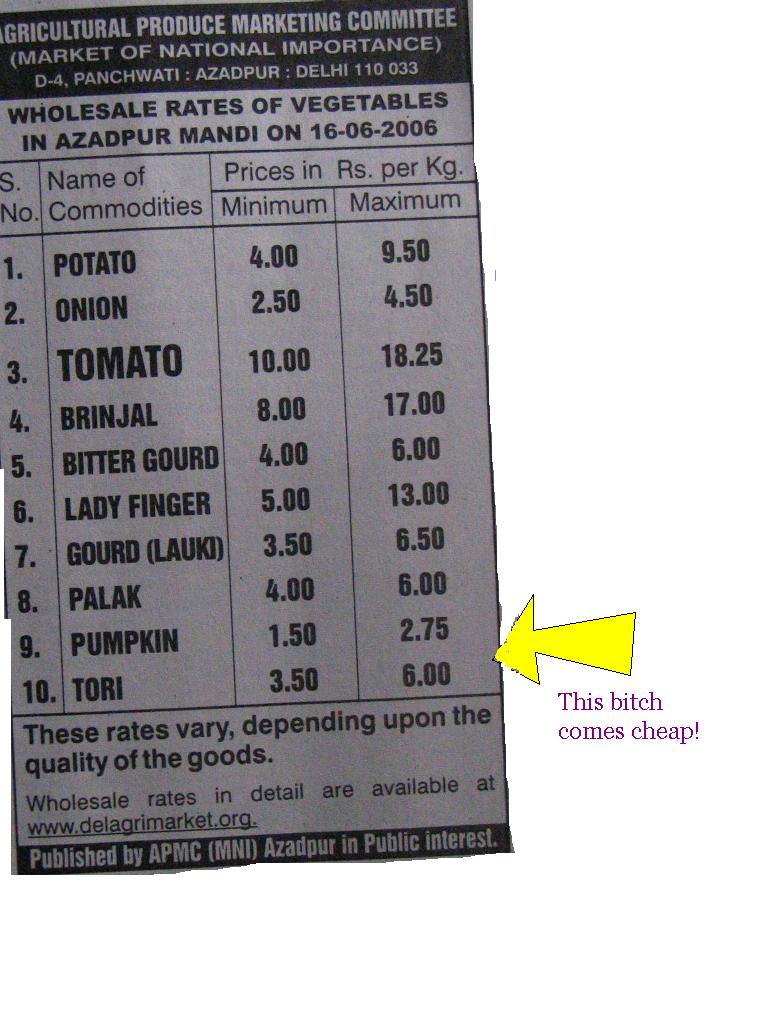
So, according to the wholesale rates at Azadpur Mandi, I am worth between Rs 220 and Rs 378 (about $4.89 and $8.40).

Wednesday, June 14, 2006

Con-GRAD-ulations (part deux)!


So it's about that time to give a shout out to all my early 20s homeboys finally getting their $100,000 diplomas; and yes, I know it's the butt end of the gradeeation season, except in Oregon and at Northwestern, so...you know my allegiances.

CONGRATS! Live it up, kiddles! Congrats to JJ, Nate B, all my other MilHi bros on the five-year plan, and members of the Daily's dead editor's club.

But the biggest and heartiest congrats to my dear bro Bryan, who, despite two terms in Iraq, just passed out of OSU. Next? Nursing school, if my memory serves me. What a guy!

And it wouldn't be a Frey-Tolman-Schauer celebration without idiotic shenanigans, so, from the front lines: my mother reports that Bryan's graduation party was attended not only by brothers, sisters, and the ne'er-do-wells we call friends, but also by a ferret who was unable to fly to Baltimore (long story), my sister Amber's obese cat, and four dogs (one of whom had just been sterilized), all sniffing each other and running between legs and whatnot. Hah!

Sunday, June 11, 2006

Those damned firangs...

...are at it again, this time buying up everything in Goa, Indians be damned. (Ahem, sarcasm.)

RE: "Buying up paradise," Raju Nayak, Indian Express, Sunday, June 11, 2006

Nayak writes:

"With indications that an international mafia could be buying up land in Goa, politicians here have started opposing the purchase of properties by foreigners, especially those staying on long-term visas. ...

'We want the laws to be changed, making it compulsory for foreigners to take police permission before they apply to buy land,' a senior officer [said]. ...

'The laws should be amended to prevent foreigners from doing business here. Most of them own small businesses and only bring ills to the state,' [said Naik, a Rajya Sabha member of Parliament]."

This is potentially an interesting story, but the version that was printed is either woefully underreported or inadequately explained. We jump from the lede to the assertion that there is a Russian mafia in the popular resort town. Insert a brief description of the type of people buying property -- i.e., foreigners on long-term visas ostensibly operating businesses. Then, facts are marshalled to somehow suggest that the foreigners who are legally buying property are not these long-term visa holders, or they're some sort of exception tot he rule, but nothing is ever really explicated. The entirety of the report seems to hinge on allusion, which, frankly, is a pretty poor case to make on page three.

It seems that this report should have been held until more concrete details could have been obtained; until some of the foreign devils buying land in Goa could be contacted. Instead, it's just more politicians shooting their mouths off about the foreign menace, no reasonable response from the other side allowed.

There may well be a Russian mafia in Goa, and they may well be detrimental to the community. But does this not make a case, rather, for the institution of better oversight, more logical laws? Why must the foregone conclusion be "banish the firangs"? We're really, really, REALLY not all here to make your lives miserable. We're not all here to exploit you. If a similar proposition was made in America -- ban all people of Indian origin from owning any property -- do you know the sort of anti-discrimination court cases that would be raised to advocate for your rights, regardless of your skin color or heritage?

Saturday, June 10, 2006

Another one bites the dust

Check: #74 (Modern Library's list of 100 best novels of the 20th century), A Farewell to Arms, by Ernest Hemingway.

Hated it much less than I expected to; actually, quite liked the writing and the story both. Bleak, honest. Would have liked to drink grappa with Henry and muse about life, its meaninglessness, wisdom, and hookers.

Quotes that caught me in the gut:

"'..you're too brave. Nothing ever happens to the brave.'
'They die of course.'
'But only once.'
'I don't know. Who said that?'
'The coward dies a thousand deaths, the brave but one?'
'Of course. Who said it?'
'I don't know.'
'He was probably a coward,' she said. 'He knew a great deal about cowards but nothing about the brave. The brave dies perhaps two thousand deaths if he's intelligent. He simply doesn't mention them.'"

"You could not go back. If you did not go forward what happened?"

"I know that the night is not the same as the day: that all things are different, that the things of the night cannot be explained in the day, because they do not then exist, and the night can be a dreadful time for lonely people once their loneliness has started."

"If people bring so much courage to this world the world has to kill them to break them, so of course it kills them. The world breaks every one and afterward many are strong at the broken places. But those that will not break it kills. It kills the very good and the very gentle and the very brave impartially. If you are none of these you can be sure it will kill you too but there will be no special hurry."

And, proof that Hemingway may be a great novelist, but not a great grammarian:

"We passed a long column of loaded mules, the drivers walking along beside the mules wearing fezes." (Strike my previous comment, of course, if the mules were indeed the ones doffing headwear.)

My heart loves you, too.

Vintage fun!

Blatant rip-offery of The Beatles courtesy '60s Bollywood revived by the Internets 2.0 (the song is "Tumse Hai Dil Ko Pyaar" from the movie Jaanwar, and is a Hindified version of "I Want to Hold Your Hand").

It's things like this that really make me regret all the hubbub about intellectual property -- because you know back in the day someone from Apple would be all up in India's face, suing and bitching and generally preventing the spasmodic, enthusiastic, joyful gyrations. And we would be all the poorer for it.

For more vintage Bollywood shout outs, watch Ghost World; the opening entree is fab.

Thursday, June 8, 2006

Howard's End

Check one more Modern Library fiction book off my list.

And, in a trend I hope to maintain, my favorite quotes from the book (written by E.M. Forster):

"Her thought drew being from the obscure borderland. She could not explain in so many words, but she felt that those who prepare for all the emergencies of life beforehand may equip themselves at the expense of joy. It is necessary to prepare for an examination, or a dinner-party, or a possible fall in the price of stock; those who attempt human relation must adopt another method, or fail."

"Looking back on the past six months, Margaret realized the chaotic nature of our daily life, and its difference from the orderly sequence that has been fabricated by historians. Actual life is full of false clues and signposts tha tlead nowhere. With infinite effort we nerve ourselves for a crisis that never comes. The most successful career must show a waste of strength that might have removed mountains, and the most unsuccessful is not that of the man who is taken unprepared, but of whom who is prepared and is never taken."

"She need trouble him with no gift of her own. She would only point out the salvation that was latent in his own soul, and in the soul of every man. Only connect! That was the whole of her sermon. Only connect the prose and the passion, and both will be exalted, and human love will be seen at its highest. Live in fragments no longer. Only connect, and the beast and the monk, robbed of the isolation that is life to either, will die." (Joan of Arcadia? Anyone? Anyone?)

Wednesday, June 7, 2006

Co-worker: "I am bored to the extent of dying of boredom"

Although e-mail has brought us all closer together, a universal language -- sorry, Esperanto -- is still far from being commonplace. Global organizations have made do, batting correspondence across waters for years, but I didn't realize until lately the personal pitfalls of those unfamiliar with the preferred system of communication.

As an editrix, I make a lot of trade-offs between descriptive and prescriptive grammar -- between language as it is spoken or written on the ground and the rule books (Chicago, AP, Strunk and White) to which I cling so dearly. Although my Indian colleagues tend to have rather good grammar if you judge them by, for example, The Cambridge Grammar of the English Language (Huddleston and Pullum), it's a battle to explain that using American business style is not a compromise of quality but rather another way of seeing language -- a perspective that must be adopted as companies increasingly look to India for knowledge workers focused on global correspondence.

These musings are prompted by a visitor from my company's New York office who oversees two women that schedule interviews and thus correspond with people from Paris to Poland, China to Chicago, South Africa to Switzerland. She pulls me into her cubicle one day, and hands me a print out. "These," she says, "are examples of the e-mails the girls have been sending out. Since you are, after all, an American and know what American business style sounds like, can you read through these and make suggestions to them about how to improve their written English?"

The communiques were peppered with words many of my compatriates consider archaic -- shall, henceforth -- and lacked the assertive voice so often confused as brash unconcern for anyone's affairs but one's own. Neurotic, perfectionist to the core, I compiled ten or so "best practice" templates expressing information in what I considered a courteous, respectful, and direct manner. "Perfect," the overseer said, "now there are no excuses for this bad grammar, bad punctuation."

Yesterday, one of the girls called me over to her desk and asked me to read through a new draft of a letter. "Is this too rude?" The template has been mangled, the word "please" appears two or three times in thirty words, and passive construction abounds.

"Well...it's alright, but I think your boss wanted you to start using those samples I suggested?"

"But...they're just so rude!"

I shrugged, discussed the dilemma, and let it be. It's not really my place to be the arbiter of international language standards; however, I do wonder how this will evolve.


Befuddled? An illustration:

EXAMPLE

Dear ___,

Kindly ignore the previous mail. Request the schedule stand for date at time. The dial in details are being mailed.

BEST PRACTICE

Dear ____,

Please ignore the scheduling mail sent date at time. This message was sent in error.

Your discussion with our editors on “__________" will take place date at time, as previously discussed. Details on how to dial in and connect to the call will be sent shortly.

Sunday, June 4, 2006

Consumerist!

I bought a desk that looks like this today. And I am so, so, so, SOOO excited by it.

We went to Amar Colony and picked it up for Rs 2,100 (a little under $50). And it's tons better than the one in this pic because it's painted an old antiquey white and has nice scrollwork on it. Yeah, I know, it would be better if it was a nice kind of wood, but it appears to be a mix of perhaps mahogany and plyboard, so it's just as well that it's painted.

Lyric of the day:
"Love is the answer to a question that I've forgotten and I know I've been asked...is it possible that all this magic went unnoticed?"

Thursday, June 1, 2006

101 things update

I can cross off my list:

43) Sleep without the air conditioning once during Delhi’s summer. A circuit shorted last Saturday night, leaving me sweating and miserable, but still semi-rested.

62)
Have my Dooney and Burke purse repaired (lining resewn and zipper replaced). S took it to the Chinese shoemaker's shop, where they seamlessly did the work for Rs 150. Talk about bang for the buck.

101) Publish this list on my blog.
Well...duh.

And, progress on the big ones:

32) Read all novels on the Modern Library’s list of “the 100 best novels” (http://www.randomhouse.com/modernlibrary/100bestnovels.html
I've now read (most recent bolded):
#2 The Great Gatsby F. Scott Fitzgerald
#4 Lolita Vladimir Nabokov
#6 The Sound and the Fury William Faulkner
#7 Catch-22 Joseph Heller
#15 To The Lighthouse Virginia Woolf
#21 Henderson the Rain King Saul Bellow
#28 Tender is the Night F. Scott Fitzgerald
#31 Animal Farm George Orwell
#41 Lord of the Flies William Golding
#48 The Rainbow D.H. Lawrence
#55 On the Road Jack Kerouac
#64 Catcher in the Rye J.D. Salinger
#67 Heart of Darkness Joseph Conrad
#75 Scoop Evelyn Waugh
#76 The Prime of Miss Jean Brodie Muriel Spark
#78 Kim Rudyard Kipling
#90 Midnight's Children Salman Rushdie
#94 Wide Sargasso Sea Jean Rhys
#96 Sophie's Choice William Styron

33)
Read all books on the Modern Library’s list of “the 100 best nonfiction books” (http://www.randomhouse.com/modernlibrary/100bestnonfiction.html)
I've now read (most recent bolded):
#4 A Room of One's Own Virginia Woolf
#21 The Elements of Style William Strunk and E.B. White (well, reread it, because it's just THAT good)
#58 Out of Africa Isak Dinesen
#86 This Boy's Life Tobias Wolff
#96 In Cold Blood Truman Capote

Down with Da Vinci

Da Vinci code ban in India state

Perhaps I don't adequately understand the contours of religious discontent in India. But I have to say...I simply don't understand the threat governments see from screening The Da Vinci Code.

According to the BBC:

"The government of the southern Indian state of Tamil Nadu has banned the release of the Hollywood film The Da Vinci Code ...
The decision to ban the film followed appeals from local Christian leaders who felt that the film might hurt the community's religious sentiments. Tamil Nadu is the fourth Indian state that has banned the screening of the film, which was released last week."

I'm just sick of...well, I guess it might be the sheer size of the democracy. I mean, don't get me wrong. I believe in democracy. I don't want any other system of governance. But when there's more than a billion people in a country, everything is always both true and false.

It would be one thing if the government was being consistent; say, they ban The Da Vinci Code and also admit that there are reasons to believe that communal disharmony is a tangible threat. This is not at all the case.

Exhibit A:
India protests over pope comments. What did popey poo say? He criticized India in a speech for what he called "disturbing signs of religious intolerance." It could be construed as a potshot at the BJP (a Hindu fundamentalist party), or as an acknowledgment of the 2002 communal riots in Gujarat, sparked off by the burning of a train carrying Hindu pilgrims which may or may not have been caused by Muslims, as was suggested by some.

Any way you slice it, it seems that on one hand, Indian leaders are trying to prevent discord among India's panoply of faiths, as well as deny the existence of any problem.

(An aside: Are religious tolerance and freedom of expression mutually exclusive? Is it intolerant to ban a movie seen as betraying some religious sentiments, or is it just undue censorship? If we are free to worship, are we also not free to dissent?)

Exhibit B:
Aamir Khan, a Bollywood star whose recent movie Fanaa was boycotted in Gujarat. Why? He made a completely benign statement about restitution for people displaced from their land by a dam project (think Arundhati Roy's constant spiel); thrown in there somewhere was a blanket statement that he thought it was bad that people died in 2002's violence. In a BBC interview, Khan states:

"I think it is (Vadodara incident) very sad and what happened in Gujarat a few years ago was also equally unfortunate. It's a shame that the administration is not able to control the situation there and it is resulting in deaths of innocent people ... It doesn't matter which religion these victims belong to. The bottom line is they are all human beings. It seems to me that the law and order machinery or the administration is simply not capable of controlling the situation."

To ban his movie in the state because he expressed sympathy is reprehensible. I hear everyday tolerance this, multiplicity that. But...in real life, does it mean anything at all?


Sunday, May 28, 2006

Doctor, doctor!

Two or threes ago, in the halcyon days of undergraduate experimentation in a gender studies major, I took a class on women and medicine which, instead of talking about Clara Barton and whatnot, instead looked at the ways in which medicine is inscribed upon certain societies. For awhile, I thought this was all radical claptrap -- but living in Delhi, it is immediately apparent that the way one views medicine is heavily, heavily influenced by the way in which is is conceptualized by society.

(Interstices: Other important factors for coming to this conclusion include reading Foucault at the same time I read Mountains Beyond Mountains by Tracy Kidder. And, also, I am perpetually plagued by disease -- real or imagined.)

So ANYWAY, I was having all this existential angst about finding a good psychiatrist in Delhi, who doesn't charge an arm and a leg (because I WILL NOT claim this on my health insurance as I think the Indian HR bitch would use this as an excuse to fire me, global nondiscrimination policy or not), and who is also still operating (there is a massive medical strike that's been on for three or so weeks now to protest reservations for scheduled castes, scheduled tribes, and other backwards castes -- and if you don't understand what I'm talking about, message me, or read something from the Indian Express on the issue, which is aboslutely fascinating). And I was bitching and fretting and moaning, and finally S just suggested we go to a chemist and try and buy my presciption medicine without a prescription, because, well, this is India.

And...in less than 10 minutes, I got the medicine I was having a nervous breakdown about running out of. The clincher? A month's supply in the U.S. of this medicine (generic name quetiapine, used to treat schizophrenia, primarily) costs about $120 (though it's free through my insurance plan). Here? I bought a two-week supply as a test case, and it cost $1.50.

I am a little...I just don't know. Now I'm agonized at the evilness of Big Pharma and insurers and etc. I need to write something and submit it to an American paper, because...think of all the people who are homeless in America (and abroad, I suppose, but I haven't read the literature) because they are mentally ill. The medicine is prohibitively expensive and getting it requires numerous doctor's consultations, a possible reason so many lapse in treatment and end up completely unable to function. What if they could buy it at a reasonable price? What if not all our medicines were marketed and branded and intellectual-propertied, etc.? Even though I believe in the bottom line...why isn't there some sort of conscience underneath the layers and layers of bureaucracy?

Of course, I'm not suggesting that this medicine should be as freely available as it is here - I could be any bum. Americans are much more savvy about medicines, it's much more in your face, etc. But there should be some happy medium, no? Should I follow S's suggestion and start stockpiling pills of all kinds for illicit importation and sales to the underprivileged (in my opinion, the worst idea ever, but it's something a revolutionary would do, isn't it?)?

Friday, May 26, 2006

101 Things? 1,001 Days? No sweat!

This is the coolest ever (and maybe that's just because I love lists, etc.)

The Mission:
Complete 101 preset tasks in a period of 1001 days.

The Criteria:
Tasks must be specific (ie. no ambiguity in the wording) with a result that is either measurable or clearly defined. Tasks must also be realistic and stretching (ie. represent some amount of work on my part).

MY START DATE: May 27, 2006
MY END DATE: February 21, 2009

MY THINGS!

1) Learn enough Hindi to read a children’s book without using a dictionary for translation.

2) Move back to the U.S.

3) Let my nails grow by not biting them for one month.

4) Finish knitting the blanket I began last October.

5) Work out at least four days a week (at least 20 minutes each day) every week.

6) Open a Roth IRA.

7) Read the Mahabharata translation by Rajagopalachari.

8) Read the Ramayana translation by Rajagopalachari.

9) Take the GRE.

10) Make payments that exceed, even if only slightly, the minimum payment on my student loan every month.

11) Archive my LiveJournal entries from 2001 to present.

12) Create filing system for journals, writing, and backup CDs of online information.

13) Write and submit a column to be published in Times of India, Hindustan Times, City Limits, The Hindu, or The Indian Express

14) Write at least one letter by hand per month.

15) Donate one piece of clothing every time I buy a new piece of clothing.

16) Learn to cook avial.

17) Update my resume to reflect experience with School X and MNC.

18) Write one useable chapter for a book to be based on my experiences in India.

19) Find a psychiatrist in Delhi to consult with.

20) Passionately kiss S on Ring Road.

21) Reduce my consumption of paneer tikka to one serving per week.

22) Travel to Nepal before I leave India.

23) Shop in a bazaar in Bangkok.

24) Allow S to invite people over at least one night per week without crying, bitching, or otherwise complaining.

25) Learn how to ride Betsy and/or another non-Enfield motorcycle.

26) Procure a copy of Joan of Arcadia season II on DVD, pirated or otherwise.

27) Visit all the Indian sites in 1,000 Places to See Before You Die.

28) Go to a party and have fun without getting drunk

29) Reduce backlog of Rs so that he queue has no more than 50 documents in it at any time

30) Write proposal for book on experiences in India

31) Send proposal and sample chapters to literary agents in India and U.S.

32) Read all novels on the Modern Library’s list of “the 100 best novels”– 81 to go

33) Read all books on the Modern Library’s list of “the 100 best nonfiction books– 95 to go

34) Eat at least one serving of fresh fruit per day.

35) Learn how to knit socks with turned heels.

36) Save enough money to buy a new laptop.

37) Learn enough Web do-hickies to design and host my own blog.

38) Make prints of all my pictures on Flickr.

39) Organize high school and college photographs.

40) Write and print chapbook of short stories for Christmas presents.

41) Have portraits of S and me taken.

42) Take a class on microeconomics.

43) Sleep without the air conditioning once during Delhi’s summer.

44) Review old magazines and newspapers once a month and donate any unnecessary publications to Friendicoes or other animal shelter.

45) Floss my teeth once a day for at least six straight months.

46) Wash all the dishes S and I dirty for a week without being asked to.

47) Go whitewater rafting in the Ganga.

48) Compile an address book, including former students and current colleagues, and update it once every three months.

49) Learn how to rock climb.

50) Compile a list of my 100 favorite books.

51) Make a book of knitting patterns printed from the Internet.

52) Go one week without watching television.

53) Report at least three autorickshaw drivers who overcharge, don’t use their meter, or refuse to take me to a certain area.

54) Buy an antique book.

55) Gamble on an Indian reservation.

56) Have my teeth professionally whitened.

57) Take pictures of S’s moustache bedecked with moustache wax.

58) Get a manicure.

59) Get an ayurvedic massage.

60) Conceptualize and implement a small-scale public art project.

61) Grow my own mint.

62) Have my Dooney and Burke purse repaired (lining resewn and zipper replaced).

63) Buy a formal sari – and wear it.

64) Apply sunscreen on a regular basis.

65) Refuse to badmouth anyone at work; offer only constructive criticism.

66) Learn tenets of the Chicago Manual of Style.

67) Read the Bible.

68) Experiment with aromatherapy.

69) Create and name my own cocktail.

70) Learn to count to 10 in five languages, excluding English.

71) Take the kittens to play in the park once a month.

72) Have a girl’s night out without calling or messaging S.

73) Read a popular science fiction book, as well as a popular romance novel.

74) Ask my co-workers not to use the phrase “chinky” (and tell them I don’t like receiving e-mail forwards)

75) Go wine tasting with my grandpa.

76) Go to Delhi’s toilet museum.

77) Order a cigar from “Kastro’s Cigars on Wheels”

78) Raise a huge ruckus if someone “eve teases” me

79) Visit my bizarro hometown, Milwaukee (and write about how it compares to Milwaukie)

80) Design a small tattoo and get it inked on one of my haunches.

81) Eat a worm from the bottom of a tequila bottle.

82) Read the book that won a Pulitzer Prize the year I was born (The Color Purple, Alice Walker, 1983)

83) Watch the Academy Awards’ Best Picture of the year I was born (Terms of Endearment)

84) Ask my mother why she married my father and solicit advice on marriage.

85) Visit a country in which English is not a commonly spoken language.

86) Go vegan for a week.

87) Determine whether the Schauer family store still exists in Hamburg; if it does, visit it.

88) Swim with dolphins.

89) Mend S’s favorite shirts (and, let’s face it, underroos) that he refuses to get rid of.

90) Buy saltwater taffy and eat it while watching the seals on the Oregon coast.

91) Send an anonymous letter to my favorite living writer (Joan Didion).

92) Sell, donate, or throw away 101 items.

93) Buy my sister a special, one-of-a-kind wedding gift.

94) Stay up all night and watch the sun rise.

95) Give an outrageous tip to one of the domestic workers with whom I regularly interact (newspaper man, garbage collector, dhobi).

96) Go to a buffet and eat only desserts.

97) Avoid coffee (and coffee-flavored products) for two weeks.

98) Try drinking wheatgrass.

99) Complete a 26 Things project

100) Write letters to everyone in my life I’ve truly loved (platonically or romantically) to be distributed when I die.

101) Publish this list on my blog.


Will update as I progress/complete. Wee, a fun new project! Red = completed.

Confidential to Jaydeep Ghosh

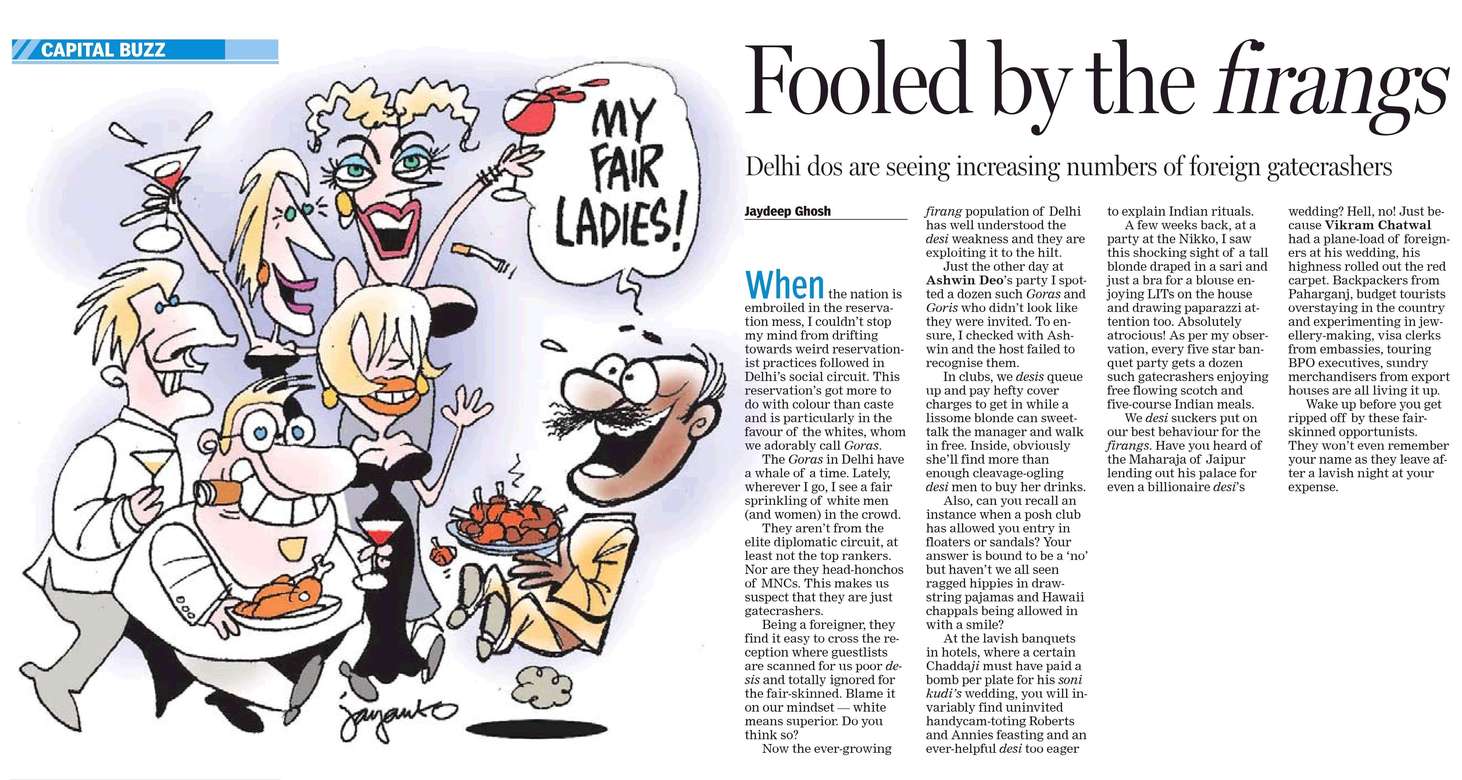
Re: "Fooled by the firangs" (HT City, New Delhi, Friday, May 26, 2006, page 3)

You are an ass.

I suspect that perhaps you've never taken the time to actually speak to one of these "fair-skinned opportunists," but you may be surprised to know that, as a white person living in Delhi, I am frequently invited to events -- such as marriages or birthday parties or office outings -- by my friends and colleagues.

It's a bracing friendliness; I often marvel at the magnitude of these events, and am amazed at the generosity of hosts who seem always willing to accomodate one more person, feed an extra mouth. Yet you exclaim, indignant, "Just the other day at Ashwin Deo's party I spotted a dozen such Goras and Goris who didn't look like they were invited. To ensure, I checked with Ashwin and the host failed to recognise them."

For the sake of argument...did you point to the woman in the bejeweled sari, snagging mutton kebab after mutton kebab? The man downing whiskies in the corner? If a dozen white folk dotted the landscape, the party must have comprised a hundred or more people -- and you would like to assert that Ashwin was personally acquainted with each and every one?

I'm not sure what precipitates this outburst, but it seems entirely unfounded. Baseless, even. You're reducing white people to...objects, not humans with feelings and thoughts and problems of their own. "A few weeks back, at a party at the Nikko, I saw this shocking sight of a tall blonde draped in a sari and just a bra for a blouse enjoying LITs on the house and drawing paparazzi attention too."

You do know that...saris aren't our native dress, and perhaps this statuesque blonde was unaware of how one procures a blouse. Or she thought that a brasseire was enough -- on more than one occasion, I've pondered the thin line between the garment and undergarment, particularly keeping in mind the fact that many blouses are of such thin cotton that the bra is completely visible anyhow. And the nerve, she, getting paparazzi attention! Surely, she was begging the photographers to chronicle her faux pas. I mean, she's white!

"The Goras in Delhi have a whale of a time," you assert. And though that may appear true enough, remember that discrimination works both ways -- perhaps you can take solace in the fact that although we guzzle an occasional free drink, our day-to-day lives are often fraught by autodrivers charging triple the metered rate; men and women pointing, staring, and laughing at our general comportment; and a crushing sense of alienation at not better understanding Indian culture.

Wednesday, May 24, 2006

Victrix!

Pleased to read in several newspapers today that, "Now, mother's name must in all official documents".

Or so says the Indian Express, Hindu, and Hindustan Times. From page 3 of IE's Delhi Newsline:

"All official documents and certificates to be issued by the Delhi government will carry the beholder's mother's name also from now onwards. The decision was taken by the Delhi Cabinet as part of the approval of women empowerment programmes...The documents include voter cards, driving licences, ... [and] birth certificates."

Having filled out my fair share of documents issued by the Indian bureaucracy, I say bravo. Because I haven't spoken to or seen my father in nine years now, and because he poisoned my mind, and because your documents give me no other options. No field to write in caveats, for example, to explain how my stepfather is really the person who has always been there for me, how my mother has stood by me no matter how low I've sunk.

It's a step. It's not "empowerment" -- but then, what is?