Umm, in case you haven't heard, a tornado hit New York. What the bloody Jesus?
It took me three hours to get from the hovel to the office -- and then when I got there, I was one of only five or so people in my department resourceful enough to navigate the wild, wild world of thousands of stranded subway users, fighting for a bus heading for the Midtown Tunnel.
I did walk about two miles, snicker at a woman trying to vanquish a foot of standing water with a small mop, invite myself to share a taxi with three people who had only limited English skills, and lost my leg to the jaws of the 7 train at the Jackson Heights station, but so be it. Delhi crowds prepared me well; whereas claustrophobic Americans were hysterically imploring fellow riders to "Act like human being, not animals!", I was smugly listening to Golmaal Golmaal ... Everything's Gonna Be Golmaal and wiggling around frenetically, my eyes glazed in bliss.
That said, I thought I would stop dealing with woefully inadequate infrastructure when I left the "third world." So much for conventional notions of modernity and backwardness ...
Showing posts with label india life. Show all posts
Showing posts with label india life. Show all posts
Thursday, August 9, 2007


Sunday, June 17, 2007


Wednesday, May 30, 2007
Just a staffer
Or, running commentary on "They are not foreigners, just staff" from today's edition of The Hindu.
"A German candidate essentially forwards a prolonged CV running into five or six pages whereas a Frenchman prefers a short, handwritten one. Russians indulge in detailed biographies and the Chinese present numerous recommendation letters to back them up. An Austrian candidate invariably lands up in highly formal attire, irrespective of the weather, while Americans are casualness personified. Australians display right attitude traits like honesty and straightforwardness at an interview and the Finns prefer to showcase their teamwork skills rather than their technical abilities. A Canadian aspirant waxes eloquent on his accomplishments while the British focus on competencies and competitiveness.
"To top it all, a Swede will definitely turn up with a trade union representative in tow.
"Contrary to what it may appear, this is not a satire on the individual job search idiosyncracies of different nationalities. It merely presents a window for recruiting foreign applicants in keeping with global trends. Yes, looking across the country's borders for fresh talent is no flash-in-the-pan."
The reporter neglects to mention that they must look beyond the borders because Indian applicants present lengthy CVs from headhunters' templates, then call every person they've ever met asking for internal company contacts, which they next proceed to hound for weeks until the HR department tells the applicant that the company will call the police if the person doesn't stop bugging its employees.
"At the time of hiring, it is necessary to understand the cultural background of the applicant apart from a comprehensive review of his qualifications. They should be made aware of issues pertaining to management of employees, peers, suppliers and others from local cultural issues. This calls for cultural sensitivity training to sensitise them to the nuances of customs, ethnicity and language."
Things I wish I'd been told before I started working in India: 1) It's not necessary to speak Hindi (or Kannada, Tamil, Bengali, or Marathi), but it's quite advantageous. People don't talk about you all the time in the mother tongue, but you'd be surprised at what they'll say when they think you're not listening. It's sort of like being a superhero. 2) It doesn't matter how hard you work -- if you're not sitting at your desk, it doesn't count to your manager. 3) Everyone wants to know who you are, how much you make, why you're here, and why you left the land of the free. If you don't want to narrate your entire life story, you'll probably be considered pricey and aloof.
"Employing foreigners calls for a higher payout rate. The employers have to offer cost of relocation, higher salaries, special perks and leaves at par with the country of their origin."
Really? Why didn't anyone tell me?
"A multicultural workforce can stir a hornet's nest too. The domestic employees may view 'the outsiders' as a threat or be peeved. Cultural differences may set the stage for tussles and misunderstandings."
In one of my favorite Indlish aphorisms, cultural differences and misunderstandings are there. But if there's one thing I've learned from my time in Dilli, it's beneficial for everyone if you come into the office with humility and an open mind. Don't be afraid to explain misconceptions, but be sure to hear what other people are saying -- there's a tremendous opportunity to learn about and improve yourself if you spend time with people who differ from you, so long as you don't imagine that you are superior by dint of the geographic serendipity of your birth.
"A German candidate essentially forwards a prolonged CV running into five or six pages whereas a Frenchman prefers a short, handwritten one. Russians indulge in detailed biographies and the Chinese present numerous recommendation letters to back them up. An Austrian candidate invariably lands up in highly formal attire, irrespective of the weather, while Americans are casualness personified. Australians display right attitude traits like honesty and straightforwardness at an interview and the Finns prefer to showcase their teamwork skills rather than their technical abilities. A Canadian aspirant waxes eloquent on his accomplishments while the British focus on competencies and competitiveness.
"To top it all, a Swede will definitely turn up with a trade union representative in tow.
"Contrary to what it may appear, this is not a satire on the individual job search idiosyncracies of different nationalities. It merely presents a window for recruiting foreign applicants in keeping with global trends. Yes, looking across the country's borders for fresh talent is no flash-in-the-pan."
The reporter neglects to mention that they must look beyond the borders because Indian applicants present lengthy CVs from headhunters' templates, then call every person they've ever met asking for internal company contacts, which they next proceed to hound for weeks until the HR department tells the applicant that the company will call the police if the person doesn't stop bugging its employees.
"At the time of hiring, it is necessary to understand the cultural background of the applicant apart from a comprehensive review of his qualifications. They should be made aware of issues pertaining to management of employees, peers, suppliers and others from local cultural issues. This calls for cultural sensitivity training to sensitise them to the nuances of customs, ethnicity and language."
Things I wish I'd been told before I started working in India: 1) It's not necessary to speak Hindi (or Kannada, Tamil, Bengali, or Marathi), but it's quite advantageous. People don't talk about you all the time in the mother tongue, but you'd be surprised at what they'll say when they think you're not listening. It's sort of like being a superhero. 2) It doesn't matter how hard you work -- if you're not sitting at your desk, it doesn't count to your manager. 3) Everyone wants to know who you are, how much you make, why you're here, and why you left the land of the free. If you don't want to narrate your entire life story, you'll probably be considered pricey and aloof.
"Employing foreigners calls for a higher payout rate. The employers have to offer cost of relocation, higher salaries, special perks and leaves at par with the country of their origin."
Really? Why didn't anyone tell me?
"A multicultural workforce can stir a hornet's nest too. The domestic employees may view 'the outsiders' as a threat or be peeved. Cultural differences may set the stage for tussles and misunderstandings."
In one of my favorite Indlish aphorisms, cultural differences and misunderstandings are there. But if there's one thing I've learned from my time in Dilli, it's beneficial for everyone if you come into the office with humility and an open mind. Don't be afraid to explain misconceptions, but be sure to hear what other people are saying -- there's a tremendous opportunity to learn about and improve yourself if you spend time with people who differ from you, so long as you don't imagine that you are superior by dint of the geographic serendipity of your birth.
Sunday, May 20, 2007
Grand opening!
 It's official: S's show is on. The opening last night went off with nary a hitch, but that's not to say that getting to the point of having pictures on the wall was an easy task.
When we showed up on Friday, the previous artist was nowhere to be found, but his paintings and photos were still sprinkled throughout the gallery. There were a few crumpled price lists, some cellophane, and a few gallery hands, but no sign of the genius who was offering a blown-up print of a packet of Maggi Dal Sambhar noodles for nearly 2 lakh rupees (about $5,000). S, I, and a gang of well-wishers were ready to start hanging, but the portly, balding artist didn't see fit to wrap things up until around 3 or 4 a.m., at which point some handymen began puttying imperfections in the walls.
 We unwrapped all the images and made a mockup of their sequence; however, as we were doing so, we discovered several problems with the framing -- wrong-colored mounting, scratched images, and so on. After tiring myself by fashioning a ball of duct tape and other packing material (applied art!) then batting it around the hall, I crashed in the gallery's lobby on two chairs pushed together; S buzzed throughout the night, returning home only for a quick two-hour nap, before spending all of Saturday chasing down the framer, fixing captions at the printer, and calling friends to remind them to attend. The last picture hit the wall at 6:30 p.m.; guests began arriving at 7 on the dot, uncharacteristically subverting the law of Indian Standard Time that dictates "punctual" means "three hours late."
There was a fair crowd, including some of our nearest and dearest friends -- as well as some typical Page 3 people, trailing the scent of success, glamour, and ... what was that? Burnt cocaine?
The most entertaining guests of the night, though, were undoubtedly the journalists, a great swarm of men who make a habit of attending every opening -- not because they are aesthetes, but because there is invariably free (albeit second-rate) whisky in the offing. They enter, make a quick chakkar, and then mill around for the remainder of the show, proffering limp handshakes to every bonny young lass as they explain the importance of a free press.
One such gem was a freelancer, a crooked, nearly bald man with a garland of hennaed hair ringing his dome. He haunts the Habitat Centre's openings, and I've met him before no fewer than three times; nevertheless, he doesn't remember me. "Hello, miss. You are with the gallery?"
"No, sir; my husband is the artist." I scan the room for S, hoping he'll intervene, but he's posing, fist against his chin, as he leans against one of his photographs for someone with video equipment.
"Ah, the artist, yes!"
A waiter approaches with a tray of drinks, and the man exchanges the glass in his hand for a fresh tumbler. He takes three big swallows, and then turns to me.
"Yes, yes. I am always talking to your husband. I have just given him my card. He is a great man, a very great man."
I nod, my eyes glassy, and excuse myself to oversee the sale of catalogs and ensure no one vandalizes the guestbook. He carresses my hand, then follows me to the table, requesting a press release about the show. I reluctantly hand him a catalog, and he sets to inscribing the register with his immortal words. After he puts the pen down, he approaches another waiter, downs another drink, and heads out into the stormy night. Curious, I scrutinize the guestbook, and find his scribbled hand.
"Perfection in all ways."
Indeed, indeed. There were many missteps, but for all the drama, it was a lovely event, refreshingly quirky and magical in its flaws.
Thursday, May 17, 2007
Polio vaccination, or delicious cod?
 While I love to brag about how much I save buying my prescription meds in India ($5 for a month's supply! Which used to cost me $500 a month in the U.S.! And I'm not dead yet!), the health-care system is far from perfect. Actually, on the fucked-up-edness spectrum, it's probably closer to "Now totally taking on the eradication of cholera, which you may remember from the Apple IIE classic, The Oregon Trail."
I was reminded of this when I opened my copy of Hindustan Times and encountered a story about how a the parents of a patient at a hospital in Kerala gave the doctor their morning catch (five kilograms of fresh pearl spot fish) -- which the harried pediatrician stacked inside a freezer in the pediatric operation ward of Kottayam Medical College. (A pharmacist discovered the fish when he restocked the freezer.)
It's not just gross negligence in hospitals; it's a lack of basic hygiene facilities for a vast proportion of the country, water shortages, inappropriate drug delivery systems, insufficient oversight to address health threats encountered by manual laborers, and grinding poverty that makes it necessary to, for example, sell one's kidney to get out of debt.
As much as people are talking about medical tourism, it seems -- as with so many other things here -- that adequate care is reserved only for the elite. I'd gladly pay more for my pills if that could, in some alterna-perfect world, help India's less privileged afford essentials like protection from mosquito-borne illnesses.
Tuesday, May 15, 2007
Just another reason I love India
 So yesterday was a rather stultifying day of red tape; I spent 10 consecutive hours at the Ministry of Home Affairs, primarily being 1) told to wait, 2) laughed at, or 3) asked why I didn't want to be a housewife. But let's put that aside for awhile. Bitterness is so passe.
The new black is belligerence, which I would like to illustrate with a short conversation shouted between a visa seeker and a visa officer.
Officer: "Why are you here again?"
Seeker, a middle-aged balding man, his rumpled purple Oxford shirt unbuttoned to reveal a delightful mass of gray chest hair: "I am needing visa! I am from Italy!"
Officer: "But you haven't followed any of the visa protocol!"
Seeker: "I have seen India! I have seen enough of India! No more!"
Officer: "One by one, you have violated the rules of the visa protocol! There is visa protocol!"
Seeker: "I WILL WAGE WAR ON INDIA AND CHINA!"
Officer: "We will put you in jail! You will be behind bars!"
Seeker: "I don't want JAIL, I want a visa! I hate your country! War!"
What surprised me most, perhaps, was that rather than being trucked off to Tihar, this individual was given what he wanted. Five hours before they addressed my concerns. I think the best thing for me to do is to stop trying to make sense of this utterly chaotic, irrational place.
Saturday, May 5, 2007
Nation and identity
 Despite its tremendous linguistic, cultural, and ethnic diversity, the image of India one draws from the media (particularly outside the subconty) is usually of the northern plains -- bhangraing Funjabis or colorful Rajasthanis, usually accompanied by a camel or two.
So I quite enjoyed this week's Outlook, which had two passable articles on Indian identities to which less attention is paid: Franco-Indians living in Pondicherry (and preparing to cast votes for either Sarkozy or Royal) and young people from the Seven Sisters (an increasing presence as employees in the capital's hippest shops and cafes).
On a related note, I just finished Pavan K. Varma's Being Indian. It's interesting, in that it tries to debunk some of the myths that have been created about India. Varma writes:
"The Indian reality is transparent and opaque simultaneously. What is visible is as much a part of the truth as what remains unseen. Foreigners see what is overt, and conflate it with their preconceived notions of 'the great Indian civilization.' In the process many assumptions evade critical scrutiny, and a great dmany inferences are either incorrect or only partially true. But foreigners can be forgiven their errors. Not so the Indians. Over the years the Indian leadership, and the educated Indian, have deliberately projected and embellished an image about Indians that they know to be untrue ... What is worse, they have fallen in love with this image, and can no longer accept that it is untrue.
"The image has been created by a quantum leap of logic, an ideological sleight of hand that derives an untenable ought from an undeniable is. India has been a parliamentary democracy since Independence in 1947; therefore, Indians are undeniably democratic by temperament. Several important religions were born and flourish in India; therefore, Indians are essentially spiritually in their outlooks. People of different faiths have found a home in India; therefore, Indians are basically tolerant by nature. Mahatma Gandhi defeated the British by relying on ahimsa; therefore, Indians are peaceful and non-violent in temperament. Hindu philosophy considers the real world as transient and ephemeral; therefore, Hindus are 'other-worldly' and unmaterialistic in their thinking. India has nurtured a great deal of diversity; therefore, Indians are of an eclectic and catholic disposition.Although there are points within Varma's narrative with which I disagree, this excerpt fairly accurately reflects the relationship I've embraced as regards explaining India. People want quick and easy answers, a 30-second soundbite about how spiritual and loving and wonderful my two years here have been. The thing is, they haven't been. Certain moments fall into these categories, but to generalize -- to try and synthesize a country of more than a billion people into neat little boxes -- is simply impossible.
"India is much too important today, and its potential far too significant in the coming decades, to be held hostage to this simplistic myth-making."
Thursday, May 3, 2007
Begging for a visual
In Kalagram, Chandigarh Tourism has opened what appears to be the country's first "condom bar" -- a themed watering hole/disco where pints are served in condom-shaped mugs and prophylactics festoon the walls. Free condoms will be distributed to patrons, and rather than returning loose change, customers will be given a handful of rubbers.
Aiming to spread awareness about HIV/AIDs and to destigmatize the usage of condoms, I applaud this new effort -- stories about which have been run in every major English-language newspaper in Delhi.
But conspicuously absent? Any accompanying visual. Is an image still too taboo for a morning read, or (as all these stories appear to have been ripped directly from a press release) was there simply no camera-ready art?
Aiming to spread awareness about HIV/AIDs and to destigmatize the usage of condoms, I applaud this new effort -- stories about which have been run in every major English-language newspaper in Delhi.
But conspicuously absent? Any accompanying visual. Is an image still too taboo for a morning read, or (as all these stories appear to have been ripped directly from a press release) was there simply no camera-ready art?
Wednesday, May 2, 2007
Dance dance revolution
You simply must watch this video (which has been spreading across the Internets like a global wildfire) of an Infosys account manager dancing -- nay, shaking a leg, getting down, gyrating, vibrating on a completely different plane.
And lest you think this is some kind of divine setup, let me assure you: I have witnessed even more horrendous acts than this, including an 8-year-old son of an executive assistant singing "Smack That" (unedited) while wearing leather pants and grabbing his crotch. Nightmares, my friends.
Sunday, April 29, 2007
The third way
In "White Skin, Brown Soul," an HT reporter takes on an interesting phenomenon -- white, natural-born citizens of India (primarily "the children of foreign immigrants — missionaries, social scientists, businessmen — who came to India in the 1950s and the 1960s").
Reporter Riddhi Shah exposits, "Much has been written about the NRI experience -- their conflicts, their battles, their struggle to come to terms with their mixed identities. But the stories of these reverse NRIs -- white on the outside and brown on the inside, 'white chocolate' to the NRI's 'coconut' -- have gone largely untold."
The story itself leaves a lot to be desired -- it's only about 300 words and attempts to synthesize the narratives of five or six people, all without really offering context or relaying the particularities of any one person's situation. Still, the topic poses interesting questions about identity and belonging in a world in which traditional boundaries are increasingly blurred. It stings when I hear people calling me gori and firang, and when children point, laugh, stare, sing songs. But I can only imagine how it would feel to have grown up in the subconty, to consider oneself Indian, and to experience the same day in and day out, endless explanations of life never quite either here nor there.
Reporter Riddhi Shah exposits, "Much has been written about the NRI experience -- their conflicts, their battles, their struggle to come to terms with their mixed identities. But the stories of these reverse NRIs -- white on the outside and brown on the inside, 'white chocolate' to the NRI's 'coconut' -- have gone largely untold."
The story itself leaves a lot to be desired -- it's only about 300 words and attempts to synthesize the narratives of five or six people, all without really offering context or relaying the particularities of any one person's situation. Still, the topic poses interesting questions about identity and belonging in a world in which traditional boundaries are increasingly blurred. It stings when I hear people calling me gori and firang, and when children point, laugh, stare, sing songs. But I can only imagine how it would feel to have grown up in the subconty, to consider oneself Indian, and to experience the same day in and day out, endless explanations of life never quite either here nor there.
Monday, April 23, 2007
Better health through impoverishment!
 India's Ministry of Health has just debuted a Web site promoting awareness about health. While I applaud them for providing information on disease prevention, nutrition, and healthy lifestyles, I'm a bit disturbed by some of the content I found in a section entitled "Indian values."
Next to a picture of women carrying earthen urns on their heads, text reads: "The glory in carrying an urn, Health through carrying an urn These women rarely developed cervical spondylosis. They were physically active and many of today's diseases were thus prevented."
Then, by a woman grinding wheat on a millstone, comes this reproach: "Health through grinding your own flour in glorious India. These glorious Indian women never developed a frozen shoulder. They were physically active and home ground pure whole grains were being consumed which are very healthy to the body. Health was through eating whole grains, health through physical activity through their daily chores."
The key message seems to be right on -- physical activity is good. But the subtext seems to be that women, in embracing urban lifestyles, are dooming themselves to unspoken tragedy. This wouldn't bother me so much if there was also a section on how men should return to the agrarian life, say, urging them to embrace manually sowing fields, but there isn't. Instead, it is presumed that women should stay in their traditional places, shunning convenience for the sake of slaving over an open fire to provide the family endless freshly made rotis (and, of course, waiting until the men finish their meals before serving themselves leftovers).
Sunday, April 22, 2007
My 'Ind'cyclopedia
In the Times of India today, Shashi Tharoor introduced an intermittent series, "A glossary of Indianness." Today he highlighted India exemplified by the letter A: for example, Ambassador (car) and Amitabh (star).
Inspired, I decided to take a quick alphabetical stab at how I perceive India.
A: Autowallahs -- they're aggravating, uncouth, and often outlandish, but their buzzing buggies are so typically India that green-and-yellow plastic rickshaws are hot sellers in the tourist trap that is CP
B: Bureaucracy -- wait in a line for four hours to have a simple yes or no question answered, then be openly mocked by the attending counterperson; infuriating and byzantine, and yet, the system (somehow, mostly) works
C: Caste confusion -- a code I can't parse; trying to sort out Yadavs, Patels, Nayyars, and Chatterjees feels like trying to read Ulysses without Cliffs Notes by my side
D: Dilli darshan -- constant exploration of the seven cities; there's always something new to see
E: Excreta -- even in Defence Colony, it's the nalla that defines the sweet smell of succes
F: Family -- the bonds are immutable, at times overwhelming; at times, I envy the uncomplicated allegiance S has to his bawdy clan
G: Gol gappas -- the best street food I've ever encountered, a complete explosion of the senses (sweet, salty, sour, crispy, wet, messy, addictive); so popular, it's inspired a nouveau cocktail including at an upmarket Delhi restaurant, featuring flavored vodka and a Kingfisher chaser
H: Hot hot heat -- when I read Ruth Prawer Jhabvala's Heat and Dust, I imagined it was dramatization. I guess this web-footed Oregonian should have watched the Weather Channel before she left the balmy Northwest for the Deccan plain
I: Izzat -- honor is paramount, and crossing the line can lead to some unhonorable consequences
J: Jewels -- rubies, emeralds, pearls, gold, all my wedding ornaments all in a row
K: K serials -- ludicrously overwrought, my co-workers can't seem to stop gossiping about these trashy soaps
L: Love -- I came, I saw, I met my husband!
M: Mystery -- regardless of how long I live here, I suppose there will always be something new to learn, an air of the unknown hanging as thick as the smog around the towering Qutab
N: Natkhat -- possibly my favorite Hindi word in terms of mouth feel, it's also the preferred moniker for my catty-kin
O: Overcrowding -- in a country of more than a billion, it's inevitable that one will sometime feel the crunch; on the bus, on the street, in chaotic lines, at the grocery store, out for dinner, it feels almost decadent to imagine asking for peace, quiet, or personal space
P: Page 3 people -- obnoxious social climbers in bejeweled, overpriced, ostentatious outfits; they're in TOI and HT, and they get lots of free drinks, but conversation begins and ends at dropping clues about how fabulous they are
Q: Qutab -- World Heritage in my backyard, but no one really knows the original purpose of the Qutab's construction -- mosque, watchtower, tower of victory?
R: Railways -- on the Shatabdi or trying to sleep in the dodgy classes on an overnight ride to Faridkot, riding the rails in India provides a glimpse at a broad slice of the subcontinent
S: Shanti -- overwhelming traffic got you down? No one will renew your visa? In laws asking when you're going to produce a son? Shanti, shanti, shanti
T: Touts -- no, I don't want your chess set; no, I don't want a squeaky puppet; I'm not interested in a slithering wooden snake, I have no use for a rudimentary copy of a Mughal miniature, and for god's sake, I don't need any Punjabi suits or cashmere stoles
U: Unbelonging -- no matter how hard I try, I'll never fit in. And that's precisely why it's so wonderful to live here; it pushes me, forces me to confront what I don't like in myself and others, and requires that I actively pursue change
V: Vexatious -- my time here has been high on character building, which is good in the long run, but in the moment? Absolutely frustrating. But, in the words of one of my journalism profs, "Bad for me, good for the story"
W: Weddings -- whether glistening five-star affairs or my own disaster-riddled court ceremony, India certainly is a land of romance
X: X marks the spot -- for a significant slice of India's population, illiteracy is still a plague, and thumbprints count for signatures
Y: Yamuna -- it's a stinking, filthy cess pool that used to be a pristine river; nonetheless, it is (or was) lifeblood for disparate communities -- drum makers, food vendors, families, Hindus, Muslims, and more
Z: Zed -- somewhat sweeter than "zee," adapting to a different ending for the alphabet song is just one of the myriad adjustments in my life in the last few years; once I embraced the Oxford comma, I knew my life would never be the same
Inspired, I decided to take a quick alphabetical stab at how I perceive India.
A: Autowallahs -- they're aggravating, uncouth, and often outlandish, but their buzzing buggies are so typically India that green-and-yellow plastic rickshaws are hot sellers in the tourist trap that is CP
B: Bureaucracy -- wait in a line for four hours to have a simple yes or no question answered, then be openly mocked by the attending counterperson; infuriating and byzantine, and yet, the system (somehow, mostly) works
C: Caste confusion -- a code I can't parse; trying to sort out Yadavs, Patels, Nayyars, and Chatterjees feels like trying to read Ulysses without Cliffs Notes by my side
D: Dilli darshan -- constant exploration of the seven cities; there's always something new to see
E: Excreta -- even in Defence Colony, it's the nalla that defines the sweet smell of succes
F: Family -- the bonds are immutable, at times overwhelming; at times, I envy the uncomplicated allegiance S has to his bawdy clan
G: Gol gappas -- the best street food I've ever encountered, a complete explosion of the senses (sweet, salty, sour, crispy, wet, messy, addictive); so popular, it's inspired a nouveau cocktail including at an upmarket Delhi restaurant, featuring flavored vodka and a Kingfisher chaser
H: Hot hot heat -- when I read Ruth Prawer Jhabvala's Heat and Dust, I imagined it was dramatization. I guess this web-footed Oregonian should have watched the Weather Channel before she left the balmy Northwest for the Deccan plain
I: Izzat -- honor is paramount, and crossing the line can lead to some unhonorable consequences
J: Jewels -- rubies, emeralds, pearls, gold, all my wedding ornaments all in a row
K: K serials -- ludicrously overwrought, my co-workers can't seem to stop gossiping about these trashy soaps
L: Love -- I came, I saw, I met my husband!
M: Mystery -- regardless of how long I live here, I suppose there will always be something new to learn, an air of the unknown hanging as thick as the smog around the towering Qutab
N: Natkhat -- possibly my favorite Hindi word in terms of mouth feel, it's also the preferred moniker for my catty-kin
O: Overcrowding -- in a country of more than a billion, it's inevitable that one will sometime feel the crunch; on the bus, on the street, in chaotic lines, at the grocery store, out for dinner, it feels almost decadent to imagine asking for peace, quiet, or personal space
P: Page 3 people -- obnoxious social climbers in bejeweled, overpriced, ostentatious outfits; they're in TOI and HT, and they get lots of free drinks, but conversation begins and ends at dropping clues about how fabulous they are
Q: Qutab -- World Heritage in my backyard, but no one really knows the original purpose of the Qutab's construction -- mosque, watchtower, tower of victory?
R: Railways -- on the Shatabdi or trying to sleep in the dodgy classes on an overnight ride to Faridkot, riding the rails in India provides a glimpse at a broad slice of the subcontinent
S: Shanti -- overwhelming traffic got you down? No one will renew your visa? In laws asking when you're going to produce a son? Shanti, shanti, shanti
T: Touts -- no, I don't want your chess set; no, I don't want a squeaky puppet; I'm not interested in a slithering wooden snake, I have no use for a rudimentary copy of a Mughal miniature, and for god's sake, I don't need any Punjabi suits or cashmere stoles
U: Unbelonging -- no matter how hard I try, I'll never fit in. And that's precisely why it's so wonderful to live here; it pushes me, forces me to confront what I don't like in myself and others, and requires that I actively pursue change
V: Vexatious -- my time here has been high on character building, which is good in the long run, but in the moment? Absolutely frustrating. But, in the words of one of my journalism profs, "Bad for me, good for the story"
W: Weddings -- whether glistening five-star affairs or my own disaster-riddled court ceremony, India certainly is a land of romance
X: X marks the spot -- for a significant slice of India's population, illiteracy is still a plague, and thumbprints count for signatures
Y: Yamuna -- it's a stinking, filthy cess pool that used to be a pristine river; nonetheless, it is (or was) lifeblood for disparate communities -- drum makers, food vendors, families, Hindus, Muslims, and more
Z: Zed -- somewhat sweeter than "zee," adapting to a different ending for the alphabet song is just one of the myriad adjustments in my life in the last few years; once I embraced the Oxford comma, I knew my life would never be the same
Wednesday, April 11, 2007
Anda ke funda
 A few weeks ago, I decided I needed new shoes. NEEDED them, and not just any shoe would do. They had to be special, and no, I didn't want to go to South Ex or Khan Market or anywhere else I had already seen; I wanted a clean slate, a totally new experience.
So S took me to Shahpur Jat, an "urban village" that also features a number of hoity-toity shops, such as The Shoe Garage, where I bought what can only be classed as hooker heels. But that's neither here nor there, because what I really want to write about is the place there where we had lunch.
Pam's Breakfast & Food Center is a fairly nondescript little joint -- clean, minimalist, festooned with posters highlighting the excellence of eggs. The day we visited, in fact, they were having an omelette festival; we ate something called a "pillow omelette," which was OK, if a little gooey, presumably because they had to stuff the eggs with a mass of processed cheese the size of my closed fist to make the dish look like a pillow.
Anyhow, you know, not the best breakfast I've had, but certainly not the worst, particularly in a city where it's damned hard to get a "Western" (i.e., not puri/sabzi or paranthas) breakfast anywhere outside of Hippieville (also known as Paharganj, where most backpackers/budget travelers stay). With our check, we were presented a comment card and a pen, the waitress hovering expectantly as I dutifully rated the food, service, and ambience.
And then I made a fatal error: I wrote down my real e-mail address, in addition to some candid remarks S urged me to record ("The omelette was alright, but it was a little ... wet."). The following Monday, I logged into my e-mail account, I was confronted with this message:
Dear Zoey,
Thank you for visiting PAM's for the Omelette Festival with TWIST.
You liked the PILLOW omelette, but, found the inside too wet and gooey. Well we have gone further and developed a mix veg omelette where we keep the cheese minimum and not all that gooey whith veg and tomatoes and cheese altogether.
We look forward to seeing you again with your friends and family. However, please ask the Table Waiter to ask the chef to make the omelette not wet inside.
Regards
Capt. Jatindar P. Shad
Whoa. Now THAT'S service. I now receive spam from them at least once a week, but at least it's inventive and mildly hilarious. And the proprietor seems to be a most intriguing man -- on the Web site, Pam's advertises free services, including individual counseling with Capt. Shad ("There is no problem of life that you cannot discuss with Capt. Shad and after you have spoken to him - you will find a new meaning to life. So let it be a difference with your associates, your boss or for that matter with your spouse, you siblings, your parents - any one - come and discuss this openly with him and find how simple it is to Be Happy."
Sunday, April 8, 2007
Tashi delek!
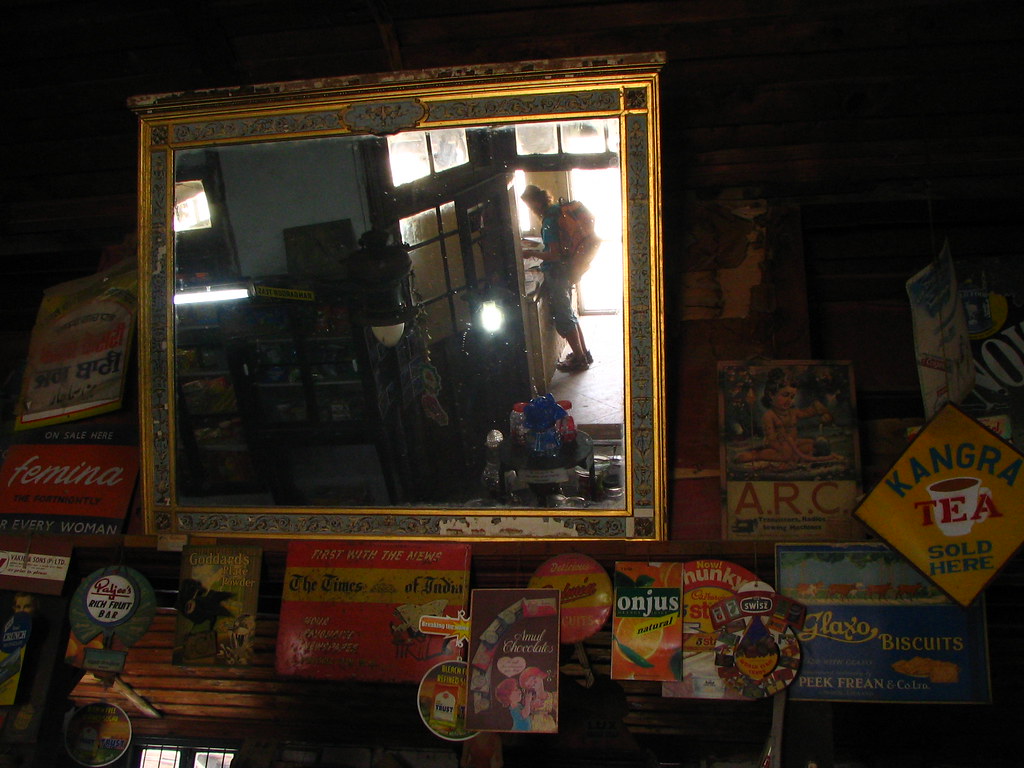 Just returned from a short jaunt to Dharamsala/McLeodganj, better known as the seat of the exiled Dalai Lama. Peaceful, restful, restorative; much off-roads rambling transpired, as did considerable and indiscriminate photographing of hand-painted signs, which is becoming something of an obsession.
At left, the old Nowrojee store, established sometime in the mid-1800s. Still sells sundries -- primarily newspapers and magazines, but also saw evidence of colas and candies being peddled; more interesting is the store's interior, which is dappled by ancient signs, dusty glash shelves, and long-expired provisions, such as several dented vat-like cans of shelled peas. Certainly an interesting visit, and a good place to meditate upon the confluence of culture, old and new, tradition, modernity, and finding a fine balance.
More to come ...
Monday, March 26, 2007
Six degrees of expat separation
You know, you'd think there'd be more variety in a country of a billion people.
Imagine, if you will, a young American expat's birthday party on a balmy Saturday night. Said expat is Miss Y. Your humble blogger? Miz Z.
Miz Z brings her husband, Mr. S., to the party, who promptly identifies Miss Y's paramour as "a guy who looks like my friend R," who indeed turns out to be his friend R (with a slightly different haircut).
Miz Z also brings her friend Big D, a freelance journalist, to the shindig, because, you know, Americans gotta stick together. Big D immediately begins talking to Miss Y, who works for a human rights foundation in Delhi that is TOTALLY Big D's "No. 1 favorite human rights organization."
Miss Y, consequently, is working for the organization in India on a fellowship that Miz Z just discovered is run by the son of Miz Z's former employer.
One of the girls also in the fellowship program (and at the party) is Easy E, who has brought her fiance to the fete. The fiance went to LaHell, the private Catholic high school located in Miz Z's home town (she went to the downmarket Milyucky).
There are two fine young people who also attended a rather exclusive Holi party attended by Miz Z et al.; another attendee is studying the '84 Sikh riots, which Mr. S did a photo essay on last year.
I could go on, but seriously, six degrees? Try one or two. It's a small world after all.
Imagine, if you will, a young American expat's birthday party on a balmy Saturday night. Said expat is Miss Y. Your humble blogger? Miz Z.
Miz Z brings her husband, Mr. S., to the party, who promptly identifies Miss Y's paramour as "a guy who looks like my friend R," who indeed turns out to be his friend R (with a slightly different haircut).
Miz Z also brings her friend Big D, a freelance journalist, to the shindig, because, you know, Americans gotta stick together. Big D immediately begins talking to Miss Y, who works for a human rights foundation in Delhi that is TOTALLY Big D's "No. 1 favorite human rights organization."
Miss Y, consequently, is working for the organization in India on a fellowship that Miz Z just discovered is run by the son of Miz Z's former employer.
One of the girls also in the fellowship program (and at the party) is Easy E, who has brought her fiance to the fete. The fiance went to LaHell, the private Catholic high school located in Miz Z's home town (she went to the downmarket Milyucky).
There are two fine young people who also attended a rather exclusive Holi party attended by Miz Z et al.; another attendee is studying the '84 Sikh riots, which Mr. S did a photo essay on last year.
I could go on, but seriously, six degrees? Try one or two. It's a small world after all.
Thursday, March 22, 2007
Don't mix drink with drive
 According to this Web site, the Mumbai Traffic Police have started disseminating these coasters (at left), which are printed with a type of red ink that only appears when wet.
Thus: Order a frosty beer; enjoy the mug, glistening sweat; finish draught; admire mugshots of people with what appear to be head wounds.
It's gruesome, shocking, tasteless, and a little bit fantastic. I love it when art and technology collide, particularly in such a public forum.
That said, I have absolutely no idea of the back story for this; when S and I were in Mumbai, we certainly didn't notice any of these while we were quaffing innumerable pints. There's also little buzz about drunk driving in recent media, so the catalyzing event for this macabre exhibition will remain a mystery for me.
Saturday, March 17, 2007
Gods in blue
 India's first match in the cricket World Cup is tonight, and the subconty's gone (even more) cricket crazy.
Exhibit A: A man in Chennai who set up a temple about six years ago has been drawing throngs with his eleven-headed god (eleven heads to represent, of course, the eleven players on the cricket pitch) and two Ganesh idols depicted bowling and batting. According to The Hindu, "Even as the temple was under construction, [the man] had prayed to Ganesha during an India-Australia match at Kolkata following which India from the verge of a collapse, made a miraculous win ... He said in that particular match, not only India won but also several records were created. Sachin Tendulkar crossed his 10,000 runs in test cricket, Harbajan performed a hat- trick besides V V Lakshman scoring 281 and Rahul Dravid 180."
Exhibit B: Ubiquitous billboards for Reebok, featuring India's cricketers -- and enticing taglines alluding to diarrhea. (OK, I know more people here associate the phrase with cricket than with gastrointestinal distress, but when it screams in 1,000-point font that someone's "got the runs," I can't help but dissolve into a fit of immature warbling.)
Exhibit C: Tihar jail, one of Asia's largest prisons, will "relax TV watching norms" and play commentary on the match over their PA system (if that's not cruel and unusual punishment, I don't know what is).
Exhibits D, E, F ...: Reuters reports that weavers in West Bengal are making saris featuring Sourav Ganguly, in Orissa a man videotaped himself trying to play cricket underwater, and a restaurant in Ahmedabad is offering a cricket-centric menu, including "googly pasta" and "century noodles."
Lock up your daughters, folks, it's going to be a wild few weeks.
Monday, March 12, 2007
Let the rain fall
Tuesday forecast: 71 degrees Fahrenheit (22 degrees Celsius) high, 55 degrees Fahrenheit (13 degrees Celsius) low.
That's right. It's March, and I haven't once been compelled to switch on the air conditioner (guiltily, trying to conceal my heat weakness from the hubby). I wore a jacket when I walked to the place where I get picked up for my carpool. There was a light mist in the air, all my co-workers were miserable, and I had the hugest smile on my face.
Take that, statistically average March max of 88 degrees Fahrenheit (31 degrees Celsius)! I don't care if my normal life has been thrown out of gear, I'm loving it.
That's right. It's March, and I haven't once been compelled to switch on the air conditioner (guiltily, trying to conceal my heat weakness from the hubby). I wore a jacket when I walked to the place where I get picked up for my carpool. There was a light mist in the air, all my co-workers were miserable, and I had the hugest smile on my face.
Take that, statistically average March max of 88 degrees Fahrenheit (31 degrees Celsius)! I don't care if my normal life has been thrown out of gear, I'm loving it.
Thursday, March 8, 2007
A whole DAY for people with vaginas?
 It's International Women's Day, an event I hardly knew existed when I was in the U.S., but one which is widely acknowledged in the good ole subconty. If you do one thing to commemorate half the world's population, perhaps it should be visiting the Blank Noise Project, which is a blog/activist group committed to intervening on the behalf of women in India.
Alternatively, you could check out information from the Indian Ministry of Women and Child Development, or head to a seminar held by the National Commission for Women entitled "Mentally Ill Women: Is Destitution the Only Answer?"
Despite the somewhat exploitative/outlandish title, I wish I had been able to attend this colloquiom. Although I don't explicitly address it that often any longer, mental illness is certainly an issue close to my heart, and living outside "my" society has only highlighted the fact that it is only a fortuitous confluence of circumstance -- gender, geographic location, parentage, historical era -- that has allowed me to study, marry, travel, and thrive.
On this (perhaps constructively) manufactured holiday, I'd like to acknowledge the strength of the women in my life, past and present. To, first and foremost, my mother and grandmother, who have modeled for me what a woman should be -- intelligent, independent, feisty, caring, and driven. To the lovely Rita, for accepting so wholeheartedly as a daughter; to all the women of S's family for being thoughtful and involving me in all the family's gatherings. To my best girlfriends from "home," Dina, Mandi, Janessa, and Elaine; and to my most excellent women colleagues (and our single male team member!). There are miles to go before we sleep, but we have, indeed, come a long way.
[Mush aside: Lots of interesting coverage in the news in relation to gender, &c. A short selection of the panoply of articles ...
"Women Struggle to Find Place in Modern India" (DNA)
"Two Steps Forward, One Backward" (Inter Press Service)
"Only 14% Women in Top Management in India" (Rediff)
"Mumbai Taxi Service: No Men Allowed" (CNN)
"Tiny Steps to a Women's March" (Times of India)
"Women to be Kept Off Combat" (Hindustan Times)
"Veet Celebrates Women's Day With Launch of Indian Website" (Indiantelevision.com)]
Sunday, March 4, 2007
Holi moley!


 HOLI HAI! S and I, quite a few bhangs in. We celebrated at a party at the Art Room. Lots of colors (the dress I was wearing was cream colored in the morning), lots of merriment, lots of foreigners. And LOTS of bhang thandai.
Subscribe to:
Posts (Atom)