Showing posts with label journalism. Show all posts

Tuesday, July 31, 2007

Big fat Sikh wedding (Get it? Sikh and Greek rhyme, and there was that movie ...)

The Delhi Sikh Gurudwara Management Committee is urging the Sikh community to make weddings more modest in a bid to end female foeticide, on the precept that the burden on the woman's family to pay for such celebrations is driving the community's sex ratio down.

Their suggestions? No meat, no alcohol, and festivities finished by noon.

It's an interesting suggestion, and certainly one that I might support (if I knew slightly more about the political machinations surrounding the proclamation); however, I don't think it will do a whit of good, based upon an informal poll of my husband.

"No kebabs? Lamb roast? No rara ghost? Why else would I go to a wedding?"

(Addendum: I know that the reporter probably didn't insert the helpful callout box on Sikhism ["Sikhs are forbidden from drinking, smoking or taking drugs and should not cut their hair," "Every male should add Singh after his name and every woman should add Kaur," etc.], but bejesus. If people are interested in learning about the religion, isn't it more effective to do a little informed Googling than to spout four or five platitudes alleged to represent an entire system of belief?)

Picture: My modest (and modern) wedding to a Sikh.

Monday, July 16, 2007

NYT: Telling us things we should have known about a year ago

Only three months after the Indian embassy announced that the first consignment of mangoes exported from India to the U.S. was on its way, The New York Times is reporting the trend.

And they offer such enlightened reportage such as Nandu Patel's observation, "My customers are really happy." Patel is the manager of Patel Brothers, a grocery in Jackson Heights that is capitalizing on the desire for a taste of home by selling a box of 10 mangos for $30. (When I left Delhi, mangos were about Rs 60 [~$1.50] a pound.)


Brava, NYT. Good thing you waited three months to get the story right.

Tuesday, April 10, 2007

Confronting abuse

The Ministry for Women and Child Development (supported by Save the Children and UNICEF) has just released the results of an empirical national study on child abuse that spanned 12,500 children and 4,800 young adults in 13 Indian states. And it's a blockbuster: It asserts that two out of every three children have been physically abused and more than half of the respondents were subject to sexual abuse.

I'm a bit skeptical, primarily because none of the stories I've read have defined the exact boundaries of physical or sexual abuse, nor have they addressed the issue of methodological rigor. Prayas, the NGO that did the data collection, offers some insight on its methodology on its Web site, but a little more clarity would be nice. Statistics conceal as much as they reveal (or, in the words of Andrew Lang, "He uses statistics as a drunken man uses lamp posts -- for support rather than illumination"), and everything, from the phrasing of questions to the people deployed to collect information, can distort reality.

Regardless, this report seems like an excellent opportunity for some thoughtful follow-up reporting -- whether to broach the reliability of such surveys, to address the issue of gender as it affected the findings, to discuss ways of raising awareness and bucking the trend, &c. Will any media outlets take up this challenge, or are they content to simply project images of young girls playing barefoot in the dirt under headlines such as "Girls want to be boys"? I'm not so optimistic, but perhaps someone will prove me wrong.

Tuesday, March 27, 2007

Innovations in South Asian journalism

From Sacred Media Cow (an independent postgraduate collective on Indian media research and production spearheaded by students of SOAS at the University of London):

"Don’t trust the Indian news media? Then stop buying the newspapers and 24X7 channels. Hire your own embedded journalist to do the job for you, a private eye.

If you pay for the trip and expenses as a collective donation, I will go out and report directly to you, on this website and your cellphone by SMS. You will also have control (within reason), via sms or comments, on what I should do next.

75% of what you pay will be spent on the job at hand, and the rest are my earnings.

State your choice of place and amount donated below in comments.

Your three choices this week:

1. Nandigram, West Bengal
2. Jantar Mantar, New Delhi
3. Choose a destination"

The journalist being sponsored is DJ Fadereu, who cites this and this as similar projects.

I have to say, I'm absolutely flummoxed, but perhaps someone with a few more paisa than I would be interested in a little direct research?

Thursday, January 4, 2007

Oh, the nerdy things copyeditors do

Good (bad?) headline split in the Hindustan Times today, top of the front page, left side:

"Big fish face
the heat now"

I immediately sucked my cheeks in and started using my hands as fins, a defensive posture I adopt when I want to express my embarrassment or delight. Aaah! Big fish face!!!

That's probably not what the editors wanted to people to envision, considering the story accompanying the headline is about a police skirmish resulting from what may or may not have been serial killings of children in a satellite town of Delhi ...

Disclaimer: This picture is from the good folks at the Manteca Chamber of Commerce, who hosted a comedy night in 2005 at which people apparently mimicked our finned friends. Visit their site, and visit their city, and make as many fish faces as humanly possible.

Wednesday, January 3, 2007

Where all my Medilldos at?

Well, if you believe David Simon's prognostications in Slate, they're likely bemoaning their jobs and hoping to escape the biz.

Based on my informal research and much Google Talking, it's pretty accurate. No one wants to do more with less, and everyone wants to escape and write for a place that doesn't hand out 35 pink slips a quarter. Short inventory of my close newsy homies: three have changed jobs in the past year, and at least two others are on the lookout for better options. Hrm.

From a "what sucked/what rocked about 2006" article:

"David Simon, executive producer, The Wire; former metro desk reporter, The Baltimore Sun
In the year past, we've been given the clearest indications yet as to the future of the daily newspaper in America. And that future is brutal, reductive, and ever-less relevant.

The Los Angeles Times, which thought itself to be in the highest tier of daily journalism and therefore immune to the economic logic, is told to eviscerate itself, and when chief editors refuse, they are summarily dismissed. The Baltimore Sun is hollowed out by a string of buyouts that began more than a decade ago. The Philadelphia Inquirer is confronted with new ownership that demands a news organization with no pretensions beyond covering its circulation area. In their desperation to float their stock prices, the big newspaper chains are slowly strangling the only thing that still makes their daily editions matter: content.

For years, the Kool-Aid drinkers from the home office have journeyed to newsrooms far and wide to explain to the ink-stained rabble that these were new times, that by attritting the numbers in the newsroom, by offering buyouts to veteran reporters, by reducing the news hole, the American newspaper could not only remain viable economically, but could—given effective management—do more with less.

Here's a secret: You cannot do more with less. You do less with less. To gather more news, to investigate more wrongs, to analyze more of the complexity of modern life, you need more experienced reporters.

What now passes for journalism outside the vale of New York or Washington, D.C., is largely an embarrassment. Good people still remain in every American newsroom, and some of them are doing their damnedest to make their product essential. But every month, there are less of them, and every month, some soul-sucking whore from atop the pyramid types yet another memo explaining why this newspaper or that no longer needs a Washington correspondent, or a labor reporter, or foreign coverage. Until the industry begins to believe that content—and only content—matters, then there isn't a power under heaven that can prevent newspapers from meaning less to our world."

Saturday, December 2, 2006

I wonder how our friend the groundnut wallah feels about all this horn tooting

In news of the meta, Times of India today reported on a forthcoming article in the International Herald Tribune that ostensibly is a piece examining the trend of Indian pride in the rising strength of the nation.

It's a bit difficult to judge the content and/or article at this point, but it's certainly something interesting that I've noticed: an incredible hubris on the behalf of (middle- or high-income) Indians about how great they are, based primarily on the fact that growth has nearly hit the magical double-digit mark for several years now.

On the one hand, it's great. Pride is a powerful motivator. But on the other hand, when one is on vacation in Cambodia and runs into another traveling Indian journalist who extemporizes on t he incredible weakness of the southeast Asian nation, it's a bit hard to swallow. For example, as a (somewhat) objective outsider, I didn't see a significant material difference between sewage systems in areas not developed for tourists in both Cambodia and India. I didn't find the Cambodian people "primitive" and "immature," as this man claimed; rather, I found them remarkably flexible for seemingly beginning to reckon with some of the havoc wreaked by the Khmer Rouge.

So it's an interesting reality check. Times of India seems completely ignorant to the fact that the article likely casts something of a skeptical light on their practice of putting a logo -- "Global Indian Takeover" -- on anything related to how awesome the subconty is (i.e., "The report reaffirms the point by taking note of a logo...with every article that indicates India's growing international presence and stature in every walk of life"), but such is the Slimes.

IHT apparently ushers evidence of Sonia Gandhi and Manmohan Singh as the only doubters of India's ascendance, noting, "'Gandhi appeared embarrassed by the mood of triumphalism about India's economic transformation, pointing out that while India was "a country of dazzling prosperity," it was also a country of "dehumanizing poverty"'".

Still, it seems that Singh's reservations about "obstacles to these dreams of superpower glory -- the educational system, a failing public health service, and a shortage of vital energy resources" will continue to fall by the wayside, at least in mainstream media. They're too busy tooting their own horns, or ogling Aishwarya Rai's goodies. It's a bit of a shame that a sensitive/balanced analysis of Indian mindsets is confined either to specialist domestic journals or international papers trying to dip their nib in India's swirling pot.

Wednesday, November 1, 2006

Headline o' the week

Courtesy Indian Express, October 31, 2006: "Americans, Americans: Why Do They Do Things So Differently?"

And, for your pleasure, if you click "read more," you can read my version of the story -- in which I have merely substituted references to America with references to India and its people, and which I call, "Indians, Indians: Why Do They Do Things So Differently?" (Tongue, of course, firmly planted in cheek.)Do you think The New York Times would consider running this on their editorial page?

Europeans call them crazy. But are Indians really crazy or do they just do their own thing?

I have always been intrigued by their use of the word "prepone." When the world refers to plans that have been fast tracked, they say "the date has been moved forward," but Indians say prepone -- even if the prefix has just been added to an coantiquated term for a type of bread!

Even if India's teas were introduced to the world by exploitative colonizers, India's beverage of choice is still chai. And how. A paper cup of milky, syrupy sweet tea filled every two hours or so. Ditto with the samosas. A couple of friends may go through several dozen of these deep-fried wonders in about an hour. I've often wondered if there's such a thing as Indian food -- apart, of course, from tandoori, Chinjabi, dal, and roti.

Talking of khana reminds me of a time when I was visiting a small Indian company. We'd been working nonstop since morning and I was beginning to feel hungry. Finally, at 2:30, I asked we could grab a bite. "Oh, I'm sorry," responded my host, "I usually don't eat until later in the afternoon. And then I just see what's in the canteen." So we walked to the cafeteria; there was enough to feed an army, but I was with someone who "just wanted to see." I got myself a liter of water and some salad, with a small bowl of dal and some boiled rice, but there were Indian and Continental choices aplenty, which my host proceeded to heap in large portions and leisurely consume, before going back for seconds -- and having four or five jalebis. And this guy just wanted to check out the scene!

The Indian economy has traditionally been a disaster. They don't bat an eyelid when government officials embezzle crores of rupees , yet they complain when their company deducts 500 rupees from their monthly take to cover the free lunches and dinners provided at the workplace. Every Indian carries a few hundred spare rupees to bribe traffic police if they're pulled over for running a red light -- who cares if these are the same people who are outraged when Transparency International publishes reports that cites corruption in the country as endemic. Is this all a grand Indian scheme to drive the rest of the world crazy?

Tuesday, October 24, 2006

Best. Story. Ever.

Ashok Das, I salute you, for "Politicians and their wild campaigns" (Hindustan Times, Tuesday, October 24), is a certified masterpiece.

I quote:

"Politicians are never known to be civil while dealing with their rivals -- not even in the best of times.

After incidents of leaders having a go at each other during assembly sessions comes the latest from Vijayawada, the erstwhile political and cultural capital of Andhra Pradesh.

It all started about 10 days ago, when Telugu Desam Party [TDP] activists in Guntur decorated a buffalo in Congress party colours and hung a placard around its neck which read: 'I am Rajasekhar Reddy. I am thick-skinned and insulated to criticism. Do whatever you like, I will not resign.'

The buffalo was taken around the streets of the town as part of the TDP's statewide campaign to force Reddy to resign in the wake of a Supreme Court order quashing the pardon granted to a murder convict.

The Congress hit back. They got a donkey decorated in the TDP's yellow colour, which, like the TDP's buffalo, carried a placard saying: 'I am Chandrababu Naidu. I speak lies and utter lies. I change my stand to suit me. I betrayed my father-in-law for the sake of power." The donkey led a procession of slogan-shouting Congressmen through the streets of Vijayawada.

Congress activists though the TDP hadn't been hit hard enough. So two days later, they took out another rally with a dog in TDP colours. This time, the placard read: 'I am Chandrababu Naidu. I only bark.'

The battle had just begun. They got a man to look like Rajasekhar Reddy and paraded him through the streets with a group of seemingly irate women chasing him and thrashing him with chappals, broomsticks, rotten eggs and tomatoes.

What were the police doing all this while? The drama was too good for them to interrupt [...]"

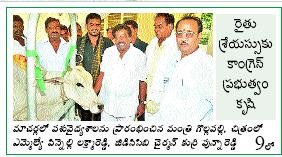
Disclaimer: This picture is from Vaarttha, a Telugu paper I found on the Interwebs. I'm not sure it's a picture of the incident (since I don't read Telugu), but it's from the paper's Guntur edition on a date near that mentioned in Das' article.